Why it exists
Metadata is often too coarse for the actual workflow.
cratemind treats a playlist as an input to a local process rather than a finished music library: audio analysis and folder structure are part of the workflow.
Case study / local-first audio tooling
A local workflow for downloading Spotify playlists, analyzing tracks for BPM, Camelot key, and genre, then organizing the results into configurable DJ-library folders.
Workflow
Start from a Spotify playlist and choose an output format and destination.
Process audio locally for tempo, Camelot key, and genre signals.
Preview, resume, and place tracks into configurable folders for a usable library.
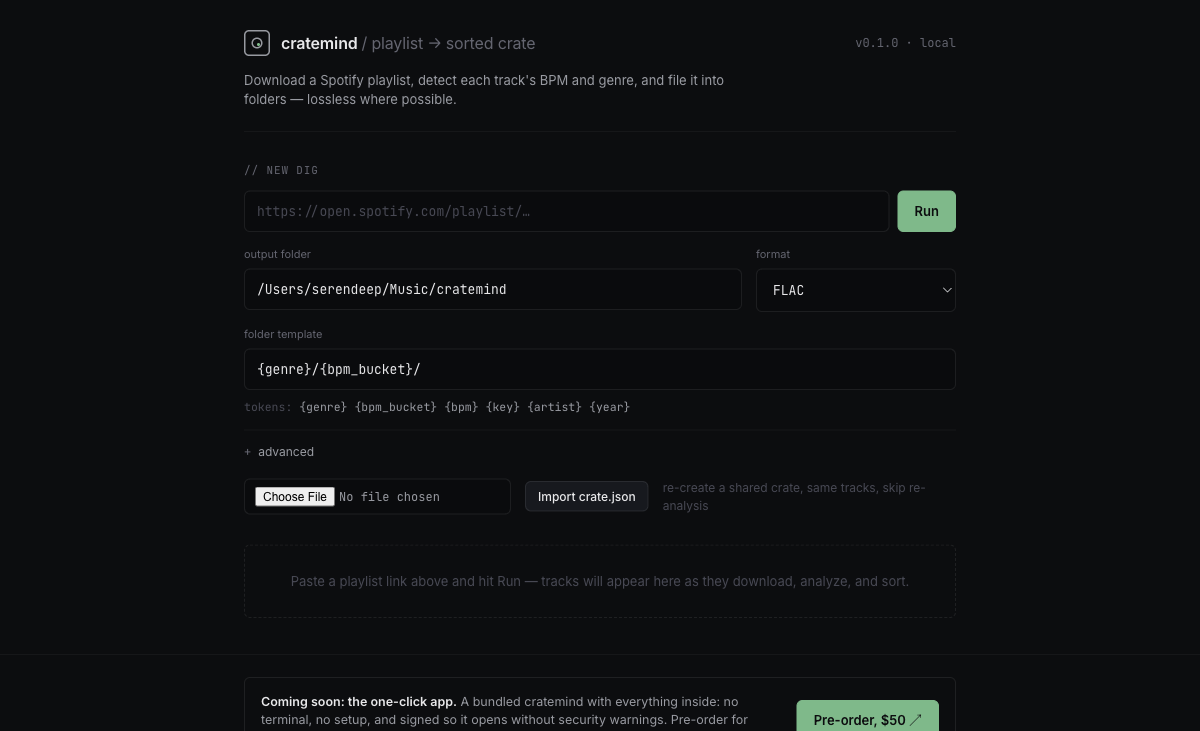
Public project interface from the cratemind repository.
Why it exists
cratemind treats a playlist as an input to a local process rather than a finished music library: audio analysis and folder structure are part of the workflow.
Engineering
Public releases run through v0.5.1. The repository includes CI on pushes and pull requests, release automation, and tests spanning analysis, downloads, pipeline behaviour, and web flows.
Technical choices
Python 3.11–3.12 coordinates a FastAPI/Uvicorn web layer with Pydantic, Mutagen, and HTTPX. Optional local analysis uses Librosa, NumPy, SoundFile, and ONNX Runtime; spotdl is invoked externally to avoid dependency conflicts.